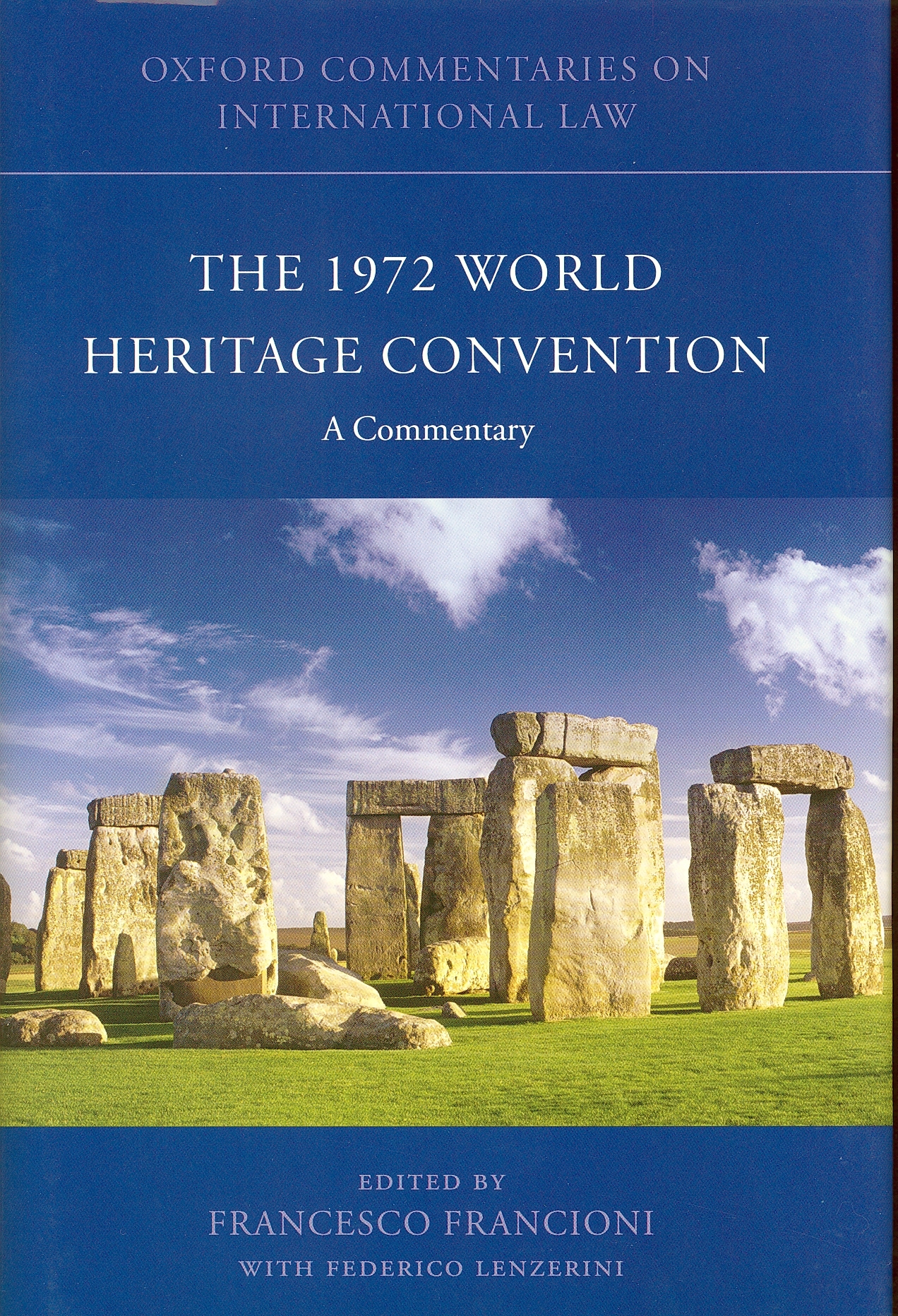
| dc.contributor.editor | FRANCIONI, Francesco | |
| dc.contributor.other | LENZERINI, Federico | |
| dc.date.accessioned | 2008-04-30T10:17:33Z | |
| dc.date.available | 2008-04-30T10:17:33Z | |
| dc.date.issued | 2008 | |
| dc.identifier.citation | Oxford ; New York : Oxford University Press, 2008, Oxford commentaries on international law | en |
| dc.identifier.isbn | 9780199291694 | |
| dc.identifier.uri | https://hdl.handle.net/1814/8508 | |
| dc.description.abstract | The World Heritage Convention (WHC) is the most comprehensive and widely ratified among UNESCO treaties on the protection of cultural and natural heritage. The Convention establishes a system of identification, presentation, and registration in an international List of cultural properties and natural sites of outstanding universal value. Throughout the years the WHC has progressively attained almost universal recognition by the international community, and even the International Criminal Tribunal for the Former Yugoslavia has recently considered sites inscribed in the World Heritage List as "values especially protection by the international community." Besides, the WHC has been used as a model for other legal instruments dealing with cultural heritage, like the recently adopted (2003) Convention on the Safeguarding of Intangible Cultural Heritage.
During its more than 30 years of life, the Convention has undergone extensive interpretation and evolution in its scope of application. Operational Guidelines, which are the implementing rules governing the operation of the Convention, have been extensively revised. New institutions such as the World Heritage Centre, have been established. New links, with the World Bank and the United Nations, have developed to take into account the economic and political dimension of world heritage conservation and management. However, many legal issues remain to be clarified. For example, what is the meaning of "outstanding universal value" in the context of cultural and natural heritage? How far can we construe "universal value" in terms of representivity between the concept of "World Heritage" and the sovereignty of the territorial state? Should World Heritage reflect a reasonable balance between cultural properties and natural sites? Is consent of the territorial state required for the inscription of a World Heritage property in the List of World Heritage in Danger? What is the role of the World Heritage Centre in the management of the WHC?
No comprehensive work has been produced so far to deal with these and many other issues that have arisen in the interpretation and application of the WHC. This Commentary is intended to fill this gap by providing article by article analysis, in the light of the practice of the World Heritage Committee, other relevant treaty bodies, as well as of State parties and in the hope that it may be of use to academics, lawyers, diplomats and officials involved in the management and conservation of cultural and natural heritage of international significance. | en |
| dc.description.tableofcontents | Part I. Introduction / The 1972 World Heritage Convention: an introduction / F. Francioni. -- Part II. Comentary. -- The preamble / F. Francioni. -- Article I, Definition of cultural heritage / A. Yusuf. -- Article I, Cultural landscape / K. Last. -- Article 2, Definition of natural heritage / C. Redgwell. -- Article 3, Identification and deliniation of world heritage properties / B. Boer. -- Articles 4-7, National and international protection of the cultural and natural heritage / G. Carducci. -- Articles 8-11, World Heritage Committee and World Heritage List / T. Scovazzi. -- Article 11, List of world heritage in danger and deletion of a property from the world heritage list / G.P. Buzzini and L. Condorelli. -- Article 12, Protection of properties not inscribed on the World Heritage List / F. Lenzerini. -- Article 13, World Heritage Committee and international assistance / A.F. Vrdoljak. -- Article 14, The Secretariat and support of the World Heritage Committee / A.F. Vrdoljak. -- Articles 15-16, World Heritage Fund / F. Lenzerini. -- Articles 17-18, Activities to support the World Heritage Fund / L. Patchett. -- Articles 19-26, International assistance / A. Lemaistre and F. Lenzerini. -- Articles 27-28, Educational programmes / V. Vujicic-Lugassy and M. Richon. -- Articles 29, Reports / B. Boer. -- Articles 30-33 and 35-38, Final clauses / F. Lenzerini. -- Article 34, The federal clause / B.Boer. -- Part III. Relation of the World Heritage Convention with other relevant international treaties. -- The 1972 World Heritage Convention in the framework of other UNESCO conventions on cultural heritage / G. Carducci. -- The World Heritage Convention and other conventions relating to the protection of the natural heritage / Catherine Redgwell. -- Part IV. Conclusions. -- The future of the World Heritage Convention: problems and prospects / F. Francioni and F. Lenzerini | |
| dc.language.iso | en | en |
| dc.relation.isreplacedby | https://hdl.handle.net/1814/76489 | |
| dc.title | The 1972 World Heritage Convention : a commentary | en |
| dc.type | Book | en |
| eui.subscribe.skip | true | |